




Generative AI Engineer vs Traditional AI Engineer: A Comprehensive Career Guide for 2026
10 Minutes
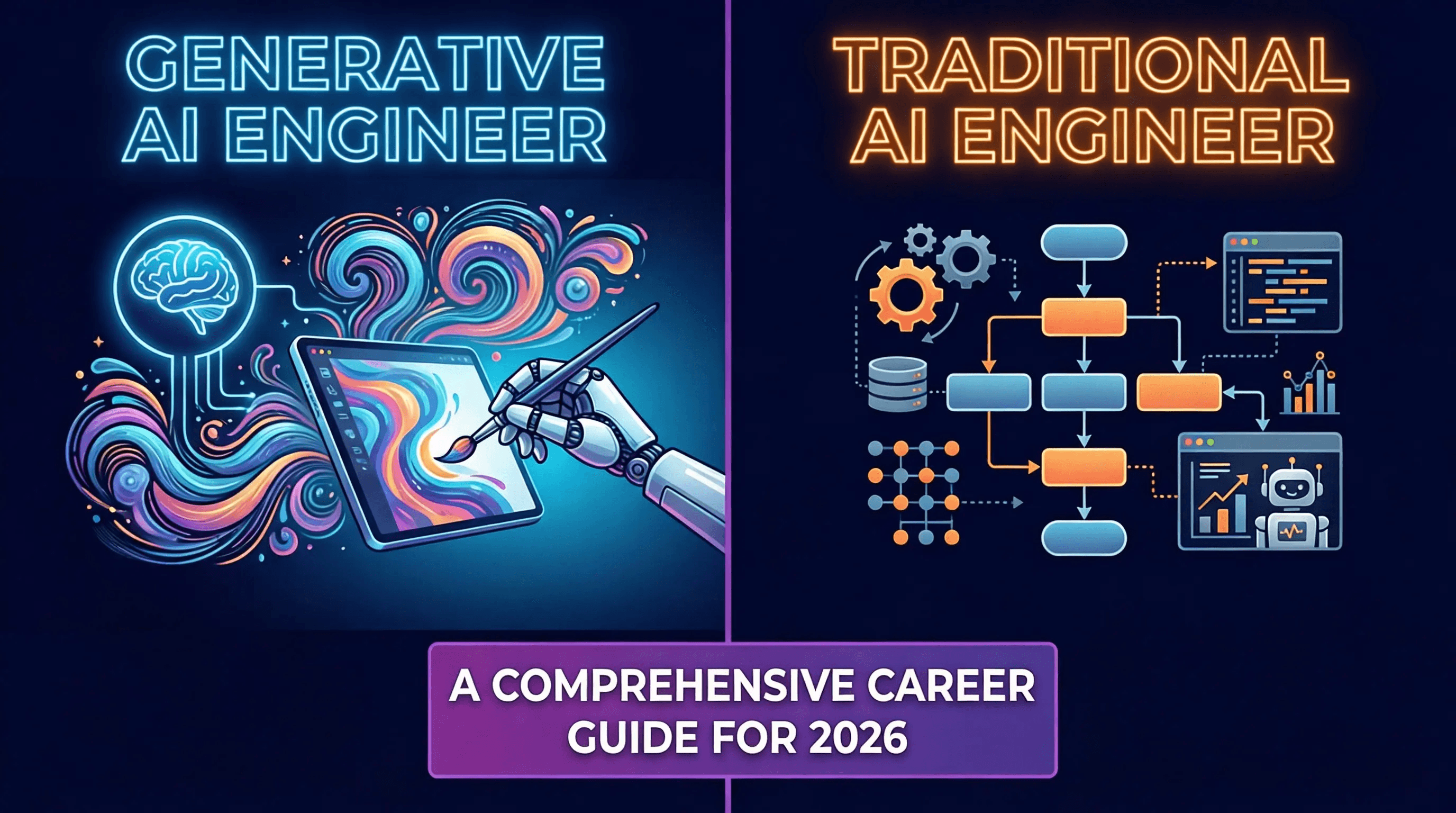
The artificial intelligence landscape in India is undergoing a dramatic transformation. As the market races toward a projected $28.8 billion valuation by 2027, two distinct career paths have emerged: traditional AI engineering and generative AI engineering. While both fields promise rewarding careers, they differ significantly in their approach, skills, and market dynamics. Understanding these differences is crucial for anyone looking to build a career in AI or transition between these specializations.
Understanding Traditional AI Engineering
Traditional AI engineering forms the backbone of many enterprise systems we interact with daily. At its core, this discipline revolves around building predictive systems that classify, optimize, and make decisions based on historical data patterns.
Traditional AI engineers work primarily with rule-based algorithms and supervised learning techniques. Their daily work centers around creating systems for specific, well-defined tasks like fraud detection in banking, recommendation engines for e-commerce platforms, or diagnostic support systems in healthcare. These systems excel at recognizing patterns in structured data and making predictions based on explicitly programmed rules and learned relationships.
The typical workflow for a traditional AI engineer involves extensive data preprocessing, careful feature engineering, and iterative model optimization to achieve accuracy benchmarks. Engineers in this field spend considerable time cleaning datasets, selecting relevant features, and fine-tuning algorithms like decision trees, random forests, or neural networks for classification and regression tasks. Once developed, these models are deployed through APIs and integrated into production environments where they handle specific, repetitive decision-making tasks.
Traditional AI thrives in structured environments with clear objectives and well-defined parameters. However, it faces limitations when encountering novel data patterns or scenarios not represented in the training data. Without human intervention to update rules or retrain models, these systems can struggle to adapt to changing conditions.
The Rise of Generative AI Engineering
Generative AI represents a paradigm shift in artificial intelligence, moving from prediction to creation. Unlike traditional AI that analyzes and categorizes existing data, generative AI creates entirely new content including text, images, code, and even video.
Generative AI engineers work with sophisticated deep learning architectures, particularly large language models (LLMs) and diffusion models. They're responsible for fine-tuning models like GPT, building applications around tools like ChatGPT and DALL-E, and handling vast amounts of unstructured data. Their work powers the next generation of AI applications, from automated code generation and content creation to personalized marketing and creative design.
The role demands expertise in prompt engineering, which involves crafting effective instructions to guide model behavior, and model orchestration, which means combining multiple AI models to create complex workflows. Safety tuning has also become critical, as engineers must address ethical concerns around bias, misinformation, and appropriate use cases.
India's Global Capability Centers (GCCs) have prioritized these skills aggressively, with demand for qualified generative AI engineers outstripping supply by a ratio of 10:1. This scarcity reflects both the field's novelty and its rapid adoption across industries seeking competitive advantages through AI-driven innovation.
Core Skills: What Sets These Roles Apart
While both career paths share foundational knowledge in programming and machine learning, they diverge significantly in their technical emphases and daily applications.
Programming and Development
Traditional AI engineers typically work with Python and R, focusing heavily on computational efficiency and algorithmic optimization. They need deep familiarity with libraries for data manipulation and statistical computing. Generative AI engineers also center their work around Python but extend into frameworks like PyTorch and specialized tools for working with LLM APIs. They spend more time on infrastructure for handling large-scale models and distributed computing.
Mathematical Foundations
Traditional AI demands rigorous mathematical grounding in linear algebra, calculus, and optimization theory. These skills underpin everything from understanding gradient descent to architecting neural networks. Generative AI engineers need strong probabilistic reasoning to work with generative models, but the mathematics tends to be more applied than theoretical, focusing on how models learn distributions rather than deriving algorithms from first principles.
Frameworks and Tools
The toolkit divergence is stark. Traditional AI engineers rely heavily on Scikit-learn for classical machine learning, TensorFlow or PyTorch for deep learning, and specialized libraries for specific prediction tasks. Generative AI engineers work extensively with Hugging Face's transformers library, LangChain for building LLM applications, vector databases for retrieval-augmented generation, and emerging tools for prompt management and model monitoring.
Data Handling Approaches
Traditional AI engineers excel at working with structured, tabular data. They invest significant effort in feature extraction, creating meaningful variables from raw data that models can learn from effectively. Generative AI engineers, conversely, work primarily with unstructured data like text corpora, image datasets, and multimodal information. Their focus shifts to fine-tuning pre-trained models, managing context windows, and handling the computational challenges of processing massive datasets.
Soft Skills and Mindset
Traditional AI roles emphasize analytical problem-solving, attention to detail, and a focus on measurable accuracy improvements. Engineers need patience for iterative optimization and the ability to translate business requirements into technical specifications. Generative AI roles demand creativity in application design, comfort with ambiguity in model outputs, and strong awareness of ethical AI governance. As these systems generate content that can influence users directly, engineers must think critically about safety, bias, and appropriate use cases.
The hiring market reflects these differences, with demand for generative AI skills like agent design and LLM orchestration growing 30-40% faster than traditional machine learning positions.
Compensation: The Generative AI Premium
The salary landscape clearly favors generative AI specialists, reflecting both the scarcity of qualified professionals and the high strategic value organizations place on these capabilities.
Entry Level (0-2 years experience)
Fresh graduates entering traditional AI roles can expect compensation ranging from 4 to 10 lakhs per annum (LPA). These positions typically involve working on well-defined problems under senior guidance, implementing existing algorithms, and learning production systems. Generative AI entry roles command 6 to 12 LPA, offering a 20-30% premium for candidates who demonstrate hands-on experience with LLMs, even through academic projects or internships.
Mid-Level (2-5 years experience)
With a few years of experience, traditional AI engineers typically earn between 8 and 20 LPA. At this level, they're expected to independently design solutions, optimize existing systems, and mentor junior team members. Mid-level generative AI engineers see compensation ranging from 12 to 25 LPA. The premium reflects their ability to architect complex GenAI applications, implement custom fine-tuning pipelines, and navigate the rapidly evolving tool ecosystem.
Senior Level (5+ years experience)
Senior traditional AI engineers with proven track records can command 20 to 40+ LPA, particularly in leadership roles or highly specialized domains. However, senior generative AI engineers push even higher, with salaries ranging from 25 to 50+ LPA. Top-tier technology companies like Amazon, Google, and leading fintech firms pay at the upper end of this range for engineers who can lead generative AI initiatives.
Geographic Variations
Location matters significantly in India's AI job market. Mumbai commands a 10-15% premium over other cities for both roles, reflecting higher living costs and concentration of financial services firms. Bengaluru, as India's tech capital, offers the highest absolute number of opportunities. Pune and Hyderabad provide competitive salaries with lower cost of living, making them attractive for many professionals.
Industry reports indicate that the average AI engineer salary across specializations has reached approximately ₹39 lakhs annually, with generative AI specialists consistently at the top end of the range. The 20-30% premium for generative AI roles stems from the intense competition for limited talent and the transformative impact these technologies have on business models.
India's AI Job Market: Opportunities and Trends
India's AI employment landscape in 2026 presents unprecedented opportunities across both traditional and generative AI domains, with over 450,000 active positions nationwide.
Geographic Distribution
Bengaluru dominates with 36% of all AI job postings, cementing its position as India's AI capital. The city's ecosystem combines established tech giants, innovative startups, and a steady pipeline of engineering talent. Mumbai and Pune follow as strong secondary markets, particularly for fintech and e-commerce applications. Hyderabad and Chennai round out the top five cities, with growing concentrations in healthcare AI and manufacturing optimization.
Industry-Specific Demand
Generative AI adoption is surging particularly in healthcare, where applications range from medical imaging analysis to drug discovery and personalized treatment recommendations. The Banking, Financial Services, and Insurance (BFSI) sector leads in both traditional and generative AI hiring, deploying predictive models for risk assessment alongside GenAI tools for customer service and document processing.
Manufacturing continues to rely heavily on traditional AI for quality control, predictive maintenance, and supply chain optimization. However, even traditionally conservative sectors are beginning to explore generative applications for design iteration and technical documentation.
The GCC Factor
Global Capability Centers have become the fastest-growing segment of India's AI job market, hiring at four times the pace of traditional IT services companies. These centers seek professionals with hybrid skills spanning both traditional and generative AI, recognizing that the most powerful solutions often combine predictive analytics with generative capabilities.
Career Transitions
The market shows remarkable openness to career transitions. Backend developers with strong programming fundamentals can add generative AI skills through focused upskilling programs, with reports of 50% salary increases within 6 months of successful transition. Traditional AI engineers can pivot to generative AI roles even faster, leveraging their existing ML knowledge while adding LLM-specific expertise.
Making Your Career Choice: Key Considerations
Choosing between traditional AI and generative AI engineering isn't just about salary numbers; it's about aligning your career with your interests, strengths, and long-term goals.
Choose Traditional AI Engineering If:
You thrive on mathematical rigor and enjoy optimizing systems for measurable performance improvements. Traditional AI offers stability in well-established domains and clear success metrics. It's ideal if you prefer working with structured data, appreciate the discipline of feature engineering, and find satisfaction in incrementally improving model accuracy. Industries like manufacturing, logistics, and traditional finance offer steady, long-term career trajectories for traditional AI specialists.
Choose Generative AI Engineering If:
You're excited by creative applications of technology and comfortable navigating ambiguity. Generative AI suits those who want to work at the cutting edge, building applications that didn't exist a few years ago. If you're fascinated by natural language processing, interested in how machines can create rather than just classify, and energized by rapid technological change, this path offers higher growth potential both in compensation and career acceleration.
The Hybrid Approach
The market increasingly values professionals who understand both paradigms. Many real-world applications benefit from combining traditional predictive models with generative capabilities. For instance, an e-commerce recommendation system might use traditional collaborative filtering while employing LLMs to generate personalized product descriptions. Building expertise across both domains positions you for the most impactful and well-compensated roles.
Structured Learning Paths
For those looking to enter or transition within AI careers, structured education programs offer significant advantages over self-learning, particularly in India's competitive job market.
Edzor's Data Science with Generative AI program, developed in partnership with Vishleshan iHub at IIT Patna, provides comprehensive coverage from machine learning foundations through advanced LLM applications. The curriculum bridges the gap between traditional and generative AI, ensuring graduates understand both prediction and generation paradigms. With an 85% placement rate within six months, the program has proven successful at launching AI careers.
For those focused on traditional AI and machine learning fundamentals, Edzor's Advanced AI/ML program in collaboration with the Technology Innovation Hub at IIT Palakkad delivers deep technical training in classical algorithms, deep learning architectures, and production deployment practices.
The IIT iHub association carries significant weight with Indian employers, offering credibility that online certifications often lack. These programs also provide hands-on project experience, industry mentorship, and placement support that accelerate career transitions.
Looking Ahead: The Future of AI Careers
The distinction between traditional and generative AI will likely blur over the coming years as engineers increasingly need capabilities spanning both domains. However, near-term trends clearly favor generative AI specialists, with year-over-year salary growth of approximately 20% driven by persistent talent shortages.
Both career paths offer compelling opportunities in India's booming AI economy. Traditional AI provides stability and proven applications across industries, while generative AI offers premium compensation and the excitement of building transformative new capabilities.
The key to success in either path lies in continuous learning, hands-on project experience, and understanding the business context in which AI systems operate. Whether you're drawn to the precision of predictive models or the creativity of generative systems, India's AI job market in 2026 offers unprecedented opportunities for skilled professionals ready to shape the future of technology.
Ready to begin your AI career journey? Explore Edzor's specialized programs and take the first step toward becoming the AI engineer that organizations are actively seeking.