




Agentic AI Careers India 2026: Skills, Salaries & Jobs
12 minutes
Introduction
Have you noticed how AI assistants are getting smarter? They're no longer just answering questions—they're taking action, making decisions, and completing complex tasks independently. This shift has a name: Agentic AI.
The tech world is experiencing a seismic transformation. According to recent industry reports, agentic AI job postings have surged by 340% in the last six months alone. Companies across India are desperately searching for professionals who understand how to build, deploy, and manage these intelligent autonomous systems.
But here's the opportunity most people are missing: while everyone rushes to learn traditional AI and machine learning, agentic AI represents a relatively untapped career field with premium salaries and explosive growth potential.
In this comprehensive guide, you'll discover exactly what agentic AI careers look like in India for 2026. We'll cover the most in-demand roles, realistic salary expectations, essential skills companies are hiring for, and a clear roadmap to break into this emerging field—whether you're a fresh graduate, working professional, or someone considering a career switch into tech.
1. What is Agentic AI? (Understanding the Breakthrough)
The Simple Definition
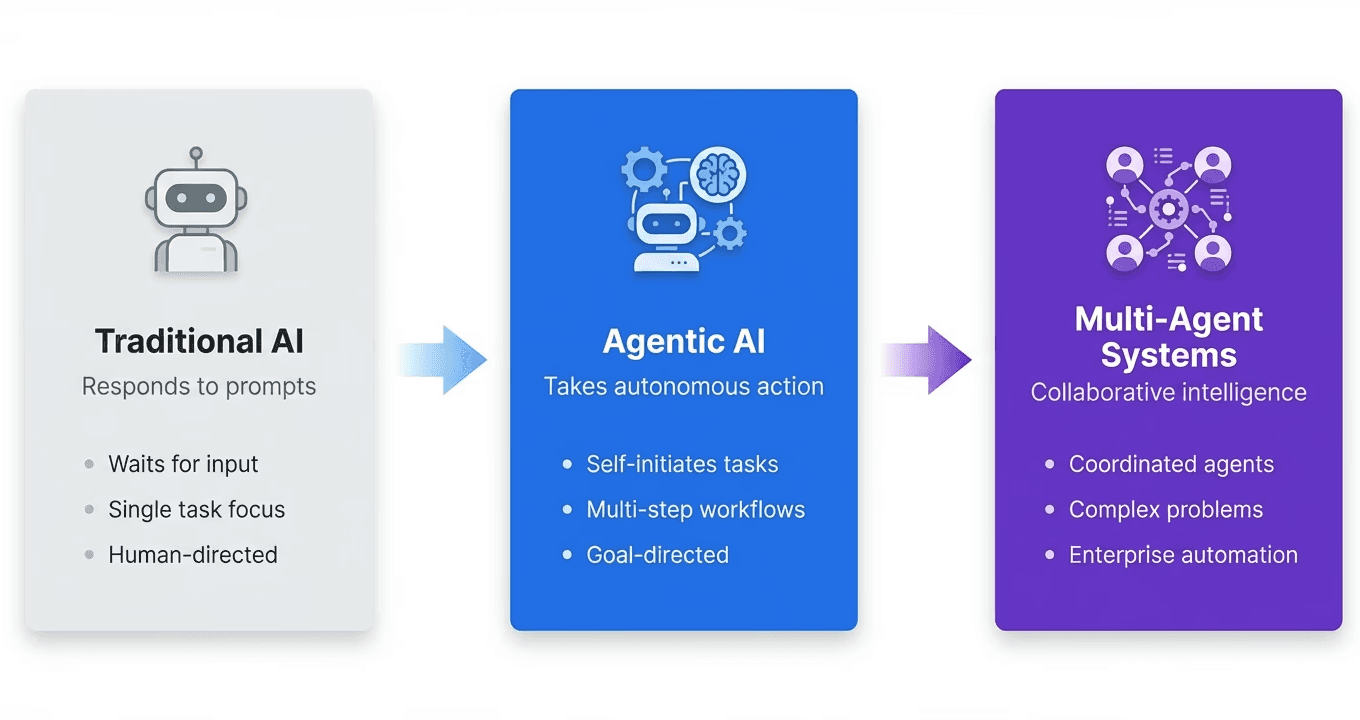
Agentic AI refers to artificial intelligence systems that can independently plan, decide, and execute multi-step tasks to achieve specific goals without constant human intervention. Think of it as the difference between a calculator that waits for your input versus a smart assistant that can plan your entire day, book meetings, send follow-ups, and adjust schedules based on changing priorities.
Traditional AI vs Agentic AI: The Key Difference
Traditional AI systems respond to prompts. You ask ChatGPT a question, it gives an answer. You give DALL-E a description, it creates an image. The interaction ends there.
Agentic AI systems take action. You tell an agentic AI to "organize our Q3 marketing campaign," and it creates task lists, assigns deadlines, drafts content, schedules social media posts, monitors performance metrics, and adjusts strategy based on results—all with minimal supervision.
Real-World Example: Customer Service Transformation
Consider a traditional AI chatbot versus an agentic AI system in customer service. The traditional chatbot answers FAQs and escalates complex issues to humans. An agentic AI customer service agent can understand the problem, access multiple databases, coordinate with inventory systems, initiate refunds, schedule technician visits, send follow-up communications, and learn from each interaction to improve future responses.
This autonomous decision-making capability is revolutionizing industries, creating massive demand for professionals who can build and manage these systems.
2. Why Agentic AI is the Hottest Career Opportunity in 2026
Market Explosion: The Numbers Don't Lie
The agentic AI market is experiencing unprecedented growth. Industry analysts project the autonomous AI sector will grow from $5 billion in 2024 to $28 billion by 2028. In India specifically, companies are investing heavily in agentic AI infrastructure, with Bangalore, Pune, and Hyderabad emerging as major hubs.
Job postings requiring agentic AI expertise increased 340% between January and November 2025. More significantly, these positions offer premium compensation—typically 20-40% higher than traditional AI roles due to the specialized skill set required.
Talent Shortage: Your Advantage
Here's the golden opportunity: while millions of professionals have learned traditional machine learning and data science, only a small fraction understand agentic AI architecture. This talent gap means companies are competing aggressively for qualified candidates, driving salaries up and creating exceptional opportunities for those who position themselves correctly.
Industry Adoption is Accelerating
Every major sector is exploring agentic AI applications. Financial services use autonomous agents for fraud detection and trading. Healthcare organizations deploy agents for patient monitoring and diagnosis support. E-commerce companies leverage agents for personalized shopping experiences and inventory management. This broad adoption means diverse career opportunities across multiple industries.
3. Agentic AI Career Roles: Where You Can Work
Agentic AI Engineer
The most fundamental role involves designing and building autonomous AI systems. Agentic AI engineers develop the core architecture that enables AI systems to plan, reason, and execute multi-step workflows independently.
Typical Responsibilities:
Designing agent architectures and decision-making frameworks
Implementing planning and reasoning algorithms
Integrating multiple AI models and tools
Testing and optimizing agent performance
Ensuring safety and reliability of autonomous systems
Salary Range: ₹10-25 LPA depending on experience
AI Agent Developer
This role focuses on creating specific AI agents for particular business applications. Agent developers work closely with product teams to understand requirements and build agents that solve real-world problems.
Key Skills:
Python and agent development frameworks (LangChain, LangGraph)
API integration and tool orchestration
Prompt engineering and LLM optimization
User experience design for agent interactions
Salary Range: ₹8-20 LPA
Multi-Agent Systems Architect
As organizations deploy multiple agents that need to coordinate, multi-agent systems architects design the infrastructure for agents to communicate, collaborate, and resolve conflicts while working toward common objectives.
Responsibilities:
Designing agent communication protocols
Building coordination and consensus mechanisms
Implementing distributed decision-making systems
Managing agent team dynamics and workflows
Salary Range: ₹15-35 LPA (senior specialized role)
Agentic AI Product Manager
Not all agentic AI careers require deep technical expertise. Product managers define strategy, prioritize features, and guide development of agentic AI products—requiring AI literacy but not necessarily coding skills.
Salary Range: ₹12-28 LPA
4. Essential Skills for Agentic AI Careers
Programming Fundamentals: Python is Your Foundation
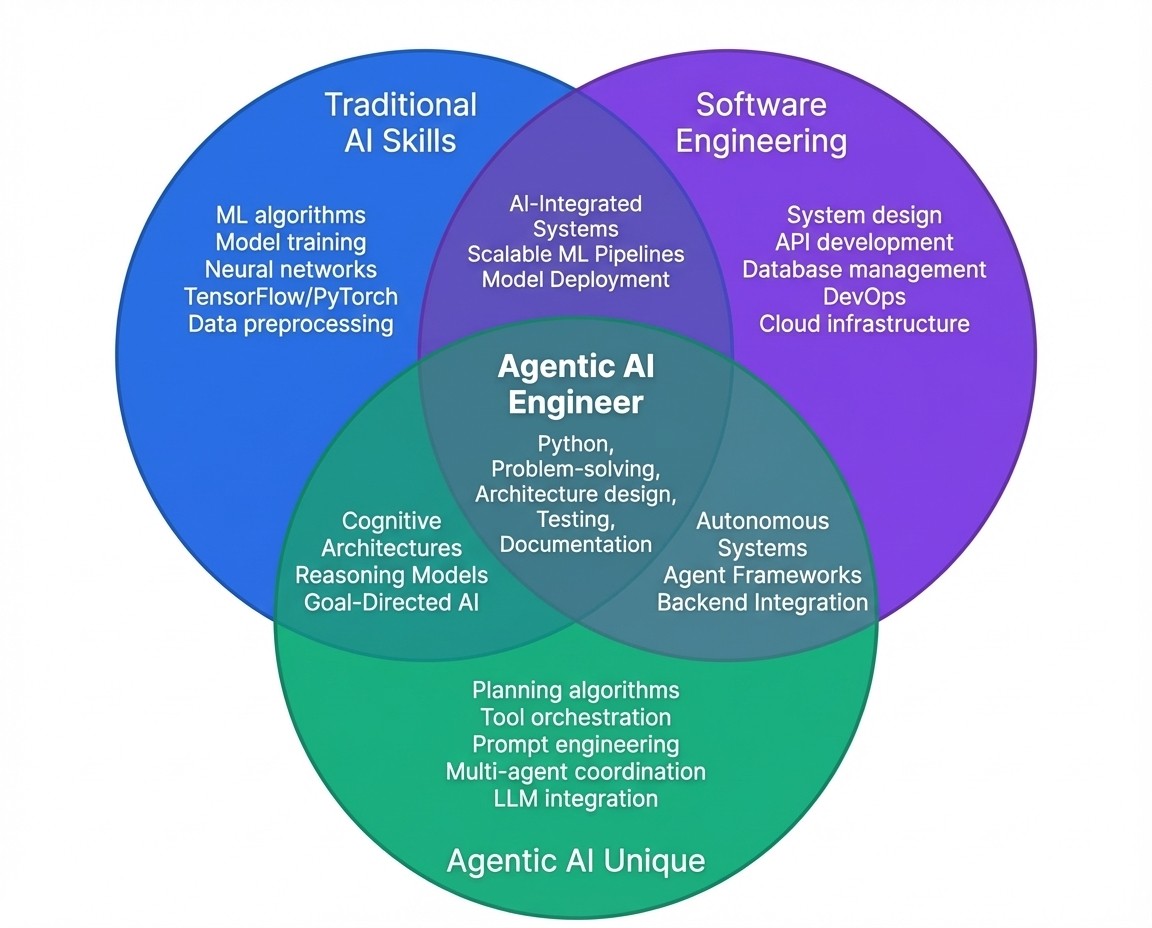
Python remains the dominant language for agentic AI development. You need solid Python programming skills, including object-oriented programming, asynchronous programming, and working with APIs. Most agentic AI frameworks are Python-based, making this skill non-negotiable.
Understanding Large Language Models (LLMs)
Since many agentic AI systems use LLMs as their reasoning engine, you must understand how these models work, their capabilities, limitations, and how to optimize them for specific tasks through prompting and fine-tuning.
Agent Development Frameworks
Proficiency with frameworks like LangChain and LangGraph is increasingly essential. LangChain provides tools for building applications with LLMs, while LangGraph specializes in creating stateful, multi-actor applications—perfect for agentic AI systems.
Prompt Engineering Mastery
Agentic AI systems rely heavily on well-crafted prompts to guide agent behavior. Advanced prompt engineering skills—including chain-of-thought prompting, few-shot learning, and prompt optimization—separate good agentic AI developers from great ones.
Planning and Reasoning Algorithms
Understanding AI planning algorithms (like ReAct, Plan-and-Solve, and Tree-of-Thoughts) enables you to design agents that can break down complex goals into actionable steps and reason about the best path forward.
Tool Integration and Orchestration
Agentic AI agents need to use various tools—APIs, databases, search engines, calculators, and more. Skills in tool integration, API management, and orchestrating multiple tools to accomplish tasks are critical.
System Design and Architecture
Building reliable autonomous systems requires strong system design skills. You need to understand how to structure agent workflows, manage state, handle errors gracefully, and ensure agents behave predictably.
5. Agentic AI Salaries in India 2026: Realistic Expectations
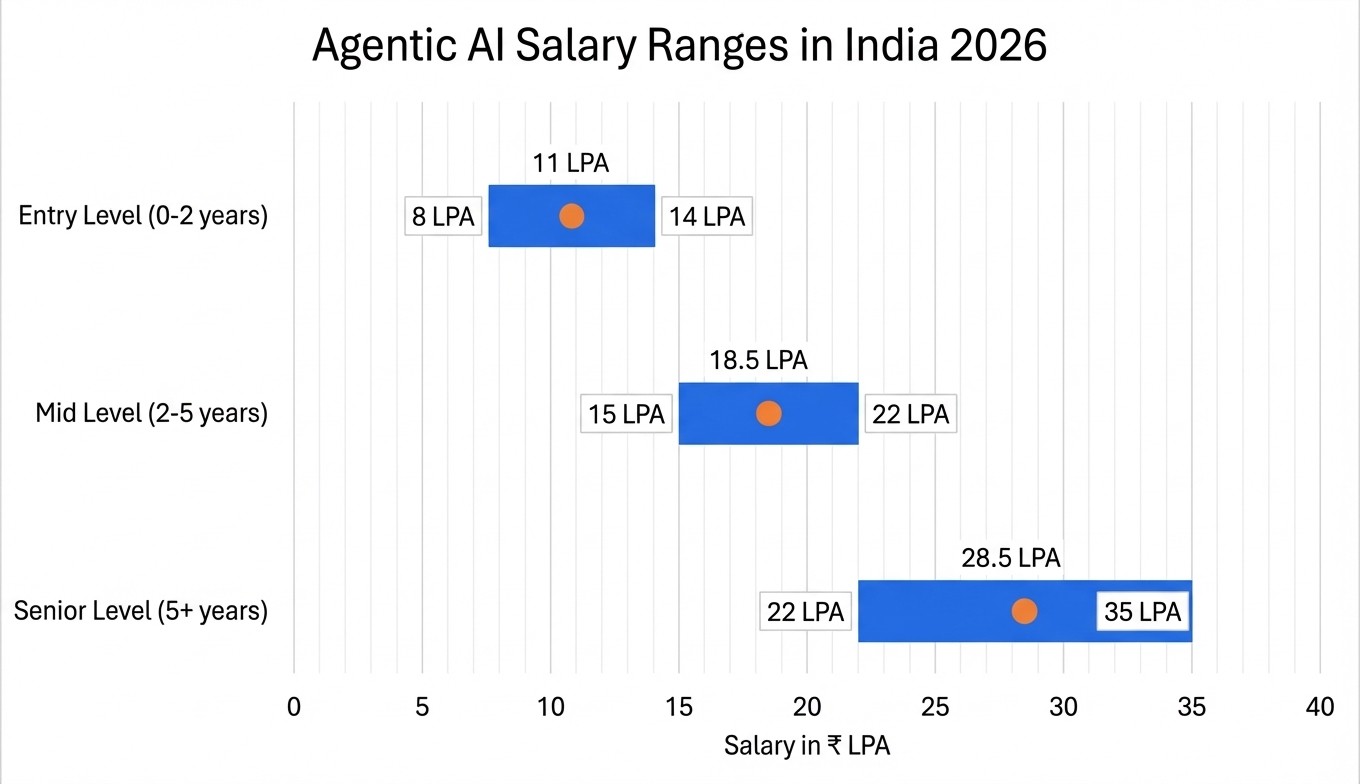
Entry Level (0-2 Years Experience)
Salary Range: ₹8-14 LPA
Entry-level positions typically involve supporting senior engineers, building simple agents, and learning frameworks. Companies hiring at this level include startups, product companies building AI features, and tech services firms.
Roles: Junior Agentic AI Developer, AI Agent Trainee, Associate AI Engineer
Mid-Level (2-5 Years Experience)
Salary Range: ₹15-22 LPA
With 2-5 years of experience (including traditional AI/ML background), professionals can command strong salaries. Mid-level roles involve independently building agents, designing workflows, and contributing to architecture decisions.
Roles: Agentic AI Engineer, Senior AI Agent Developer, AI Systems Engineer
Senior Level (5+ Years Experience)
Salary Range: ₹22-35 LPA
Senior professionals with deep expertise in autonomous systems, multi-agent architectures, or specialized domains can reach premium compensation levels. These roles involve system architecture, technical leadership, and strategic decision-making.
Roles: Senior Agentic AI Architect, Lead AI Agent Engineer, Principal AI Systems Engineer
6. Top Companies Hiring Agentic AI Professionals in India
Global Tech Giants
Google India, Microsoft India, Amazon India are heavily investing in agentic AI capabilities. Google's Gemini project includes agentic features, Microsoft is building autonomous agents into Office 365, and Amazon uses agents for logistics and customer service.
Typical Roles: Senior AI Engineer, Applied Scientist, AI Product Manager Salary Range: ₹20-40 LPA
Indian Unicorns and Startups
Flipkart, Paytm, Zomato, and Swiggy are deploying agentic AI for personalization, automation, and operations optimization. The startup ecosystem in Bangalore includes numerous AI-first companies specifically focused on autonomous agents.
Example Startups: Haptik (conversational AI), Yellow.ai (customer automation), Fractal Analytics (AI solutions) Salary Range: ₹12-28 LPA
AI Research Labs
Organizations like Wadhwani AI, Indian Institute of Science (IISc), and IIT research labs work on cutting-edge agentic AI research with real-world applications in healthcare, agriculture, and education.
Salary Range: ₹10-25 LPA (research positions often include academic opportunities)
Consulting and Services
Accenture, TCS Digital, Infosys Digital, and Wipro Digital help enterprise clients implement agentic AI solutions, creating opportunities for professionals who combine technical skills with business understanding.
Salary Range: ₹12-30 LPA
7. How to Break Into Agentic AI: Your Roadmap
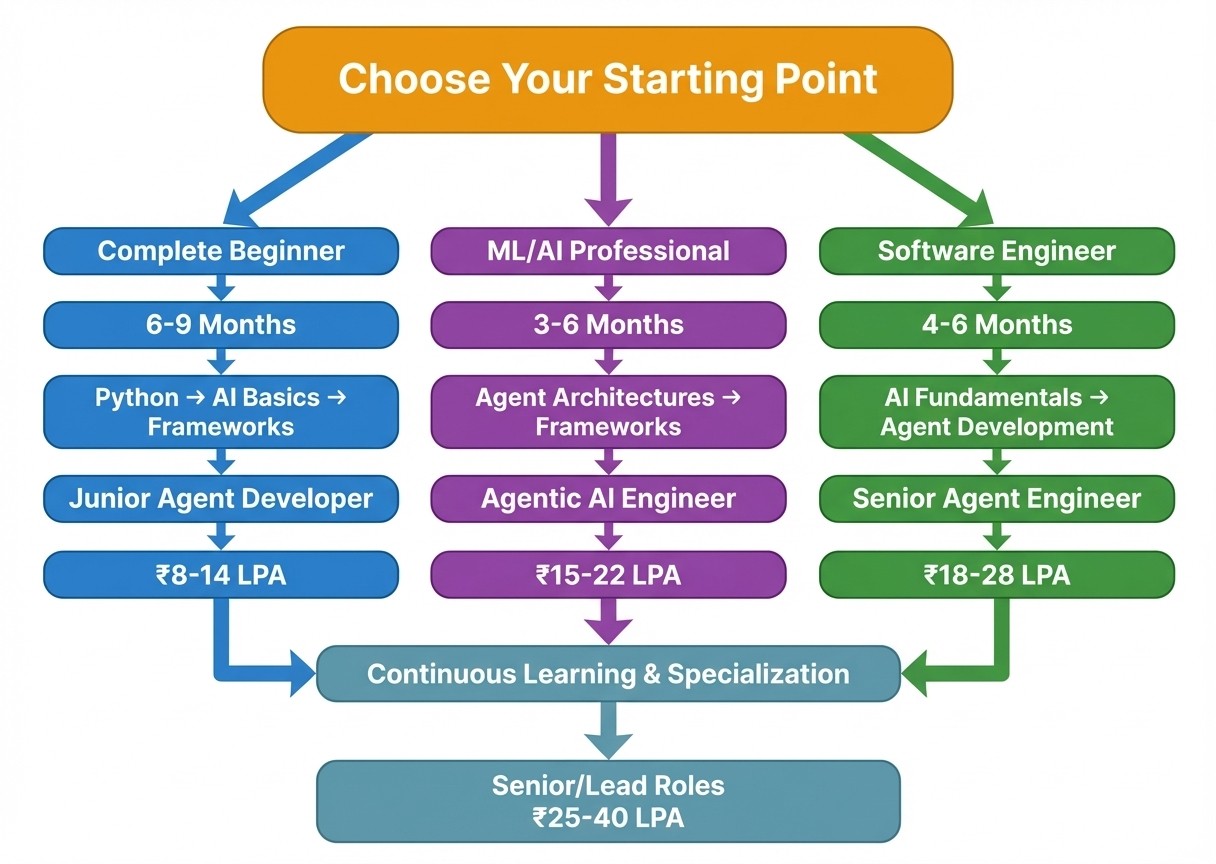
For Complete Beginners (6-9 Months Timeline)
Month 1-2: Build Programming Foundation Start with Python fundamentals. Master object-oriented programming, working with APIs, and basic data structures. Free resources include Python.org tutorials and Codecademy's Python course.
Month 3-4: Learn AI/ML Basics Understand machine learning fundamentals, neural networks, and how LLMs work. You don't need to become a research scientist, but grasping the concepts is essential.
Month 5-6: Master Agent Frameworks Dive deep into LangChain and LangGraph. Build simple agents that can use tools, maintain conversation history, and execute multi-step tasks. The official documentation and tutorials are excellent starting points.
Month 7-9: Build Portfolio Projects Create 2-3 substantial agentic AI projects. Examples: customer service agent, research assistant, workflow automation system. Document your work on GitHub and write about your learnings.
For ML/AI Professionals (3-6 Months Timeline)
Month 1-2: Learn Agent Architectures Study planning algorithms (ReAct, Plan-and-Solve), reasoning frameworks (Chain-of-Thought), and tool orchestration patterns. Read research papers and implementation guides.
Month 3-4: Master Agent Frameworks Gain proficiency with LangChain, LangGraph, and potentially AutoGen or CrewAI. Build increasingly complex agents that demonstrate autonomous decision-making.
Month 5-6: Specialize and Build Choose a specialization (enterprise automation, creative agents, research agents) and build advanced projects. Contribute to open-source agent projects to build credibility.
For Software Engineers (4-6 Months Timeline)
Month 1-2: Learn AI/LLM Fundamentals Understand how LLMs work, prompt engineering basics, and AI model capabilities and limitations. Take a crash course in machine learning concepts.
Month 3-4: Build with Agent Frameworks Leverage your strong programming skills to quickly master LangChain and LangGraph. Focus on system architecture and building production-ready agents.
Month 5-6: Advanced Topics and Projects Learn multi-agent coordination, agent observability and monitoring, and deployment best practices. Build a comprehensive portfolio project.
8. How Edzor's IIT iHub Programs Prepare You for Agentic AI Careers
Industry-Aligned Curriculum with Cutting-Edge Skills
Edzor's Data Science with Generative AI program from Vishleshan iHub, IIT Patna, includes dedicated modules on agentic AI, autonomous systems, and LLM-based applications. The curriculum covers LangChain, prompt engineering, agent orchestration, and real-world implementation—exactly what companies are hiring for in 2026.
Unlike generic online courses, our IIT iHub-certified programs are designed by IIT faculty who understand both theoretical foundations and practical industry requirements. You learn not just how to use tools, but how to architect reliable autonomous systems.
Hands-On Project Experience
Theoretical knowledge isn't enough. Our programs include capstone projects where you build functional agentic AI systems—customer service agents, workflow automation tools, or research assistants. These projects become your portfolio, demonstrating real capabilities to potential employers.
One recent graduate, Priya Sharma from Pune, built an autonomous e-commerce assistant during her capstone project. This project directly led to her placement at a Bangalore-based startup as an AI Agent Developer at ₹16 LPA—a significant jump from her previous ₹8 LPA as a traditional software developer.
Offline Learning Advantage for Complex Topics
Agentic AI involves complex concepts—planning algorithms, multi-agent coordination, distributed decision-making. Our offline, classroom-based model provides immediate access to expert instructors when you're stuck, peer collaboration for debugging, and structured learning that ensures you truly understand the fundamentals.
Research consistently shows higher completion rates and better skill retention for technical subjects taught in classroom environments compared to self-paced online courses. With 25+ centres across India, you get IIT iHub quality education in your city.
85% Placement Rate Within 6 Months
The ultimate proof is outcomes. Edzor maintains an 85% placement rate within six months of program completion. Our dedicated placement team connects you with companies actively hiring for agentic AI roles, provides interview preparation, and supports you until you land the right position.
Recent placements include positions at Flipkart, Amazon India, AI startups in Bangalore, and digital divisions of major consulting firms. Our alumni network spans 15,000+ professionals who can provide mentorship, referrals, and career guidance.
9. Frequently Asked Questions
1. Do I need a computer science degree to start an agentic AI career?
No, a CS degree is not mandatory. While it helps, what matters most is your ability to program (especially Python), understand AI concepts, and build working systems. Many successful agentic AI engineers come from backgrounds in physics, mathematics, engineering, or even self-taught programming. Focus on building demonstrable skills through projects rather than worrying about your degree.
2. How is agentic AI different from traditional machine learning?
Traditional machine learning creates models that make predictions or classifications based on data. Agentic AI uses these models (especially LLMs) as reasoning engines to plan actions, make decisions, and execute multi-step workflows autonomously. Think of ML as building the intelligence, and agentic AI as giving that intelligence agency to act independently.
3. What programming languages do I need to know?
Python is essential—it's the dominant language for agentic AI development. Familiarity with JavaScript can be helpful for web integrations, and understanding databases (SQL) is useful, but Python proficiency is your primary focus.
4. Can I transition from a non-technical background?
Yes, but it requires dedication. The path is longer (6-12 months) and involves building programming skills first. Consider starting with roles like AI Product Manager or Prompt Engineer that require AI literacy but less hardcore programming, then gradually deepen technical skills if interested.
5. Are agentic AI jobs available in smaller cities or only in metros?
Currently, most positions are concentrated in Bangalore, Pune, Hyderabad, Mumbai, and Delhi NCR. However, remote work opportunities are growing, and companies are increasingly open to hiring talent from anywhere in India. Edzor's pan-India presence means you can train locally and access national job opportunities.
6. What's the salary difference between traditional AI and agentic AI roles?
Agentic AI roles typically command 20-40% higher compensation than equivalent traditional ML/AI positions due to the specialized skills required and current talent shortage. An ML engineer might earn ₹12-18 LPA, while an agentic AI engineer with similar experience can earn ₹15-25 LPA.
7. Do I need to know advanced mathematics?
Basic understanding of statistics, probability, and linear algebra is helpful but you don't need PhD-level mathematics. Agentic AI focuses more on system architecture, tool integration, and practical implementation rather than deep mathematical theory.
8. How long before agentic AI becomes saturated like data science?
Industry experts predict 3-5 years before the market approaches saturation. The field is evolving rapidly with new frameworks, architectures, and applications emerging constantly. Early entrants (2024-2026) have a significant first-mover advantage.
9. Can I learn agentic AI while working full-time?
Yes, it's challenging but achievable with 10-15 hours weekly commitment. Edzor offers weekend and evening batches specifically designed for working professionals. The key is consistent, focused practice rather than trying to learn everything at once.
10. What happens if AI becomes even more autonomous—will these jobs disappear?
Ironically, more sophisticated AI creates more jobs, not fewer. As AI capabilities expand, we need more professionals to design, implement, monitor, and optimize these systems. The nature of work evolves, but the demand for skilled professionals increases.
10. Conclusion: Your Agentic AI Career Starts Now
The agentic AI revolution is happening right now, not in some distant future. Companies across India are desperately seeking professionals who can build, deploy, and manage autonomous AI systems. The 340% increase in job postings tells a clear story: the demand is real, the opportunities are abundant, and the salaries are compelling.
Here's what you need to remember: The best time to enter an emerging field is at the beginning, not when everyone else figures it out. Traditional AI and data science roles are becoming increasingly competitive. Agentic AI represents your chance to get ahead of the curve.
Whether you're a fresh graduate looking for your first tech role, a software engineer seeking specialization, or a professional considering a career pivot—agentic AI offers a clear path to high-paying, intellectually stimulating work that's shaping the future of technology.
The question isn't whether agentic AI will dominate the next decade of AI development. It will. The question is: Will you be ready to capture the opportunity?