




Data Science vs AI vs ML: Which Career Pays Most in 2026?
12 mins
Introduction
"Should I learn Data Science, AI, or Machine Learning?"
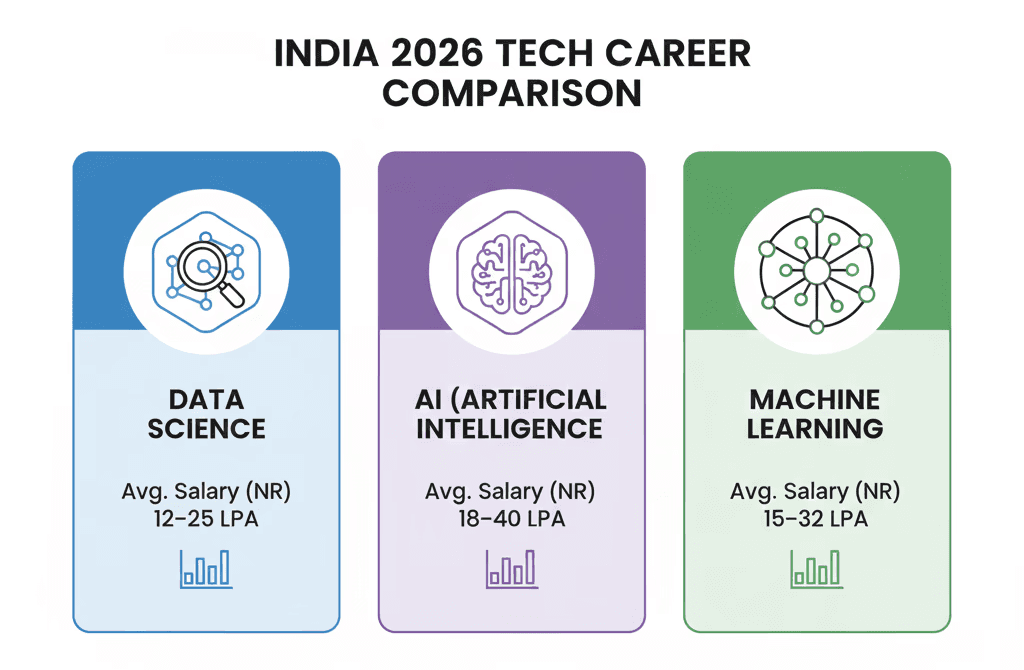
If you've asked yourself this question, you're not alone. Thousands of aspiring tech professionals in India face the same dilemma every day. These three fields are often used interchangeably, leading to massive confusion about which career path to choose.
Here's the reality: While Data Science, Artificial Intelligence, and Machine Learning are deeply interconnected, they represent distinct career paths with different skills, job roles, and salary ranges. Choosing the wrong one can cost you years of your career and lakhs in potential earnings.
According to recent industry reports, the Indian tech sector will create over 1.5 million AI, ML, and Data Science jobs by 2026. But here's the catch: only professionals with the right skill combination will command premium salaries.
In this comprehensive guide, you'll discover the exact differences between these three career paths, realistic salary expectations in India, required skills, and most importantly, a decision framework to help you choose the right path based on your background and goals.
Whether you're a fresh graduate, a working professional planning a career switch, or someone confused about which IIT iHub certification to pursue, this guide will give you clarity.
Let's decode these careers once and for all.
1. What is Data Science? (The Complete Picture)
Data Science is the art and science of extracting meaningful insights from data to drive business decisions.
What Data Scientists Actually Do:
Think of a Data Scientist as a business detective who uses data as evidence. They don't just crunch numbers—they tell stories that help companies make million-dollar decisions.
Real-world example: An e-commerce Data Scientist analyzes customer behavior data to predict which products will sell during festivals. This helps the company stock inventory optimally and save crores in costs.
Core Responsibilities:
A typical Data Scientist spends their day doing the following tasks. They collect data from multiple sources like databases, APIs, and web scraping. They clean messy data to make it usable. They perform statistical analysis to find patterns. They create visualizations that executives can understand. They build predictive models for business forecasting. Finally, they present insights to non-technical stakeholders.
Key Technologies Data Scientists Use:
Programming: Python, R, SQL
Visualization: Tableau, Power BI, Matplotlib
Statistics: Hypothesis testing, regression, probability
Tools: Jupyter Notebook, Excel, BigQuery
Machine Learning: Basic models for prediction
Where Data Scientists Work:
Data Scientists are needed in every industry. They work in e-commerce companies like Flipkart and Amazon. They analyze financial data at banks like HDFC and ICICI. They optimize healthcare outcomes at hospitals. They improve digital marketing at advertising agencies. They forecast demand in retail chains.
Bottom line: Data Science is broader and more business-focused than AI or ML. It's about solving business problems using data as the primary tool.
2. What is Artificial Intelligence (AI)?
Artificial Intelligence is about creating systems that can perform tasks requiring human-like intelligence.
What AI Professionals Actually Do:
AI professionals build systems that can think, learn, and make decisions. They're not just analyzing data—they're creating intelligent machines that can act autonomously.
Real-world example: An AI engineer at a self-driving car company builds systems that can recognize pedestrians, predict their movement, and make split-second driving decisions without human intervention.
Core Responsibilities:
AI professionals design intelligent systems and algorithms. They implement natural language processing for chatbots. They develop computer vision applications for image recognition. They create recommendation engines for content platforms. They build autonomous decision-making systems. They integrate multiple AI models into products.
Key Technologies AI Professionals Use:
Programming: Python, C++, Java
Frameworks: TensorFlow, PyTorch, Keras
Specializations: NLP, Computer Vision, Robotics
Tools: OpenAI APIs, Hugging Face, LangChain
Infrastructure: GPU computing, cloud platforms
Types of AI Work:
AI is a vast field with multiple specializations. Natural Language Processing involves working with text and speech. Computer Vision focuses on image and video analysis. Robotics means building physical AI systems. Reinforcement Learning trains agents through trial and error. Generative AI creates new content like ChatGPT and DALL-E.
Where AI Professionals Work:
AI roles exist across cutting-edge companies. Tech giants like Google and Microsoft hire AI researchers. Indian startups like Ola Krutrim build AI products. Healthcare companies develop AI diagnostic tools. Financial services create fraud detection systems. Gaming companies implement intelligent NPCs.
Bottom line: AI is the broadest field. It encompasses everything from chatbots to self-driving cars. If you want to build intelligent systems that can act independently, AI is your path.
3. What is Machine Learning (ML)?
Machine Learning is a subset of AI focused on building systems that learn from data without being explicitly programmed.
What ML Engineers Actually Do:
ML Engineers are the builders of the AI world. While AI professionals design the vision, ML Engineers make it work in production with real-world data at scale.
Real-world example: An ML Engineer at Netflix builds the recommendation algorithm that suggests shows you'll love. The system learns from millions of users' viewing patterns to make increasingly accurate predictions.
Core Responsibilities:
ML Engineers have specific technical tasks. They prepare and clean large datasets. They select appropriate ML algorithms for problems. They train models on historical data. They tune hyperparameters for better accuracy. They deploy models to production environments. They monitor model performance and retrain when needed.
Key Technologies ML Engineers Use:
Programming: Python, Scala, Java
Libraries: Scikit-learn, XGBoost, LightGBM
Deep Learning: TensorFlow, PyTorch, Keras
MLOps: Docker, Kubernetes, MLflow
Cloud: AWS SageMaker, Azure ML, Google Vertex AI
Types of Machine Learning:
There are three main types of ML work. Supervised Learning uses labeled data for classification and regression. Unsupervised Learning finds patterns in unlabeled data through clustering. Reinforcement Learning trains agents through rewards and penalties. Deep Learning uses neural networks for complex patterns.
Where ML Engineers Work:
ML Engineers are in high demand everywhere. Fintech companies build credit scoring models. E-commerce platforms create dynamic pricing engines. Logistics companies optimize delivery routes. Healthcare firms develop disease prediction models. Cybersecurity companies detect threats automatically.
Bottom line: ML is more technical and implementation-focused than general AI. If you love mathematics, statistics, and getting your hands dirty with algorithms, ML is your sweet spot.
4. Data Science vs AI vs ML: The Key Differences
Let's break down the differences clearly using a comparison framework.
Scope and Focus:
Data Science is the broadest field. It focuses on extracting insights from data for business decisions. The end goal is actionable business intelligence.
AI is about creating intelligent systems. It focuses on building machines that mimic human intelligence. The end goal is autonomous decision-making systems.
Machine Learning is a subset of AI. It focuses on algorithms that learn from data. The end goal is predictive models that improve over time.
Think of it This Way:
Data Science is like being a business analyst with strong technical skills. You answer questions like "Why did sales drop last quarter?"
AI is like being an inventor. You build systems that can think and act. You answer questions like "Can we make a chatbot that feels human?"
ML is like being a specialized engineer. You build the engine that powers AI. You answer questions like "How can we predict customer churn with 95 percent accuracy?"
Skills Overlap:
Here's where it gets interesting. All three fields share some common ground. Everyone needs strong Python programming skills. Everyone uses statistical thinking. Everyone works with data. Everyone understands basic ML algorithms.
But each field has unique requirements. Data Scientists need strong business communication and data visualization skills. AI professionals need deep knowledge of neural networks and specialized AI frameworks. ML Engineers need production engineering skills and algorithm optimization expertise.
Career Path Differences:
Data Science careers often lead to Analytics Manager or Chief Data Officer. AI careers progress to AI Architect or AI Research Lead. ML careers advance to ML Engineering Lead or Applied Science Manager.
5. Salary Comparison in India for 2026
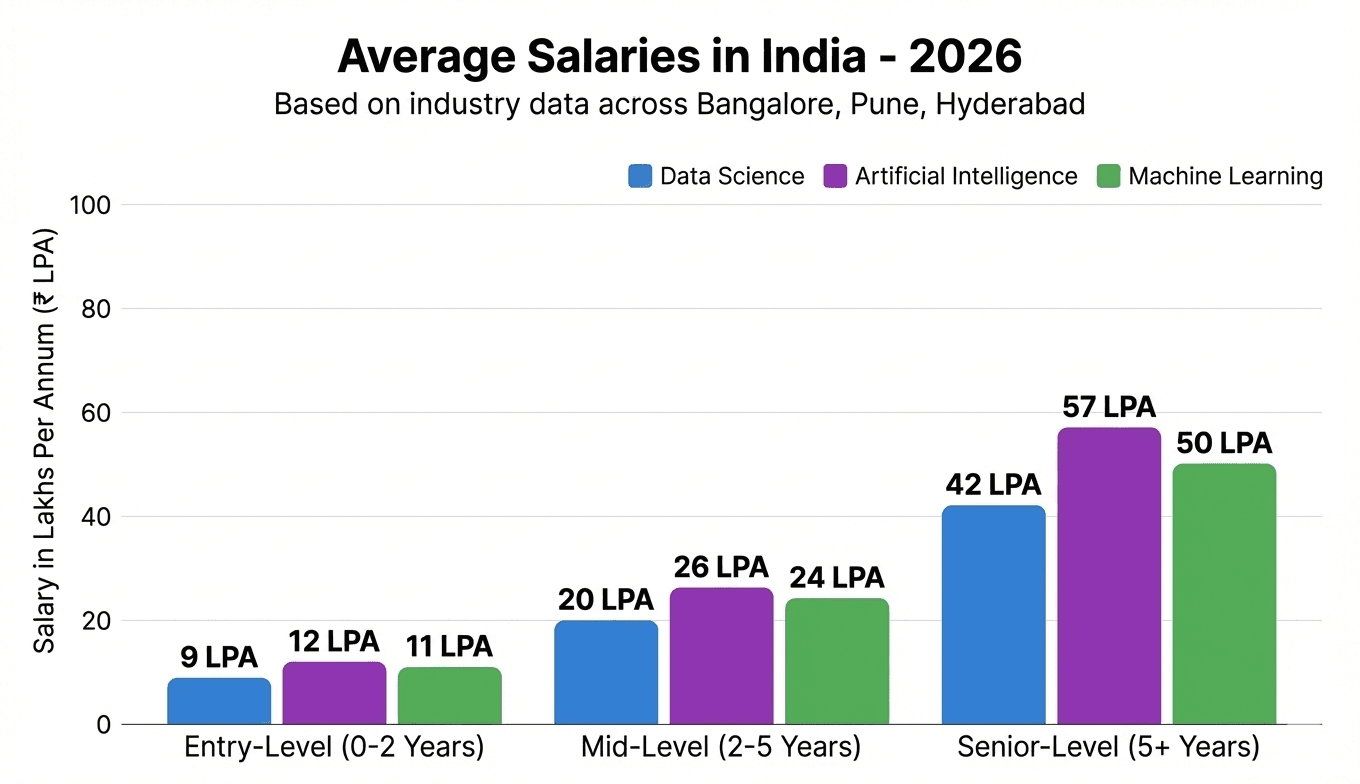
Let's talk numbers. Here's what professionals in each field actually earn in India during 2026.
Entry-Level Salaries (0-2 Years Experience)
Data Science Roles:
Junior Data Analyst: ₹6-9 LPA
Data Scientist: ₹8-12 LPA
Business Intelligence Analyst: ₹6-10 LPA
AI Roles:
Junior AI Engineer: ₹10-14 LPA
NLP Engineer: ₹9-13 LPA
Computer Vision Engineer: ₹10-15 LPA
Machine Learning Roles:
ML Engineer: ₹9-13 LPA
ML Ops Engineer: ₹8-12 LPA
Data Engineer: ₹7-11 LPA
Winner at Entry-Level: AI and ML roles typically pay 15-25% more than Data Science roles because they require deeper technical skills.
Mid-Level Salaries (2-5 Years Experience)
Data Science Roles:
Senior Data Scientist: ₹15-22 LPA
Lead Analytics: ₹18-25 LPA
Product Analyst: ₹14-20 LPA
AI Roles:
Senior AI Engineer: ₹20-30 LPA
AI Product Manager: ₹22-32 LPA
Research Engineer: ₹18-28 LPA
Machine Learning Roles:
Senior ML Engineer: ₹18-28 LPA
ML Architect: ₹20-30 LPA
Applied Scientist: ₹19-29 LPA
Winner at Mid-Level: AI roles command the highest salaries, followed closely by ML. Data Science remains slightly lower unless you move into leadership.
Senior-Level Salaries (5+ Years Experience)
Data Science Roles:
Principal Data Scientist: ₹30-45 LPA
Director of Analytics: ₹35-55 LPA
Chief Data Officer: ₹50-80+ LPA
AI Roles:
AI Architect: ₹40-60 LPA
Head of AI: ₹50-75 LPA
VP of AI Research: ₹60-100+ LPA
Machine Learning Roles:
Principal ML Engineer: ₹35-55 LPA
ML Engineering Manager: ₹40-65 LPA
Director of ML: ₹50-80+ LPA
Winner at Senior-Level: Leadership roles in all three fields converge at similar salary ranges, but AI and ML still maintain a 10-20% premium.
City-Wise Salary Variations:
Salaries vary significantly by location in India.
Bangalore: Highest salaries, 10-15% above national average. AI Engineer mid-level: ₹25-32 LPA.
Pune and Hyderabad: Competitive rates, on par with national average. AI Engineer mid-level: ₹20-28 LPA.
Delhi NCR and Mumbai: Strong demand, slightly below Bangalore. AI Engineer mid-level: ₹18-26 LPA.
Tier-2 Cities: 20-30% lower but lower cost of living. AI Engineer mid-level: ₹15-22 LPA.
Salary Boosting Factors:
Certain factors can significantly increase your earning potential. IIT iHub or premier institute certification adds 20-30%. Publications or open-source contributions add 15-25%. Specialization in hot areas like Generative AI adds 30-40%. Remote work for US companies can double your salary. Multiple framework expertise adds 10-15%.
Reality Check: Don't choose a career solely based on salary. Pick what you enjoy and are good at. Excellence in any field will eventually lead to premium compensation.
6. Skills Required for Each Career Path
Let's break down exactly what you need to learn for each path.
Data Science Skills:
Programming Skills: Python for data manipulation, R for statistical analysis, SQL for database queries.
Mathematics and Statistics: Descriptive statistics and probability, hypothesis testing and A/B testing, regression and correlation analysis.
Data Manipulation: Pandas and NumPy for Python, data cleaning and preprocessing, handling missing data.
Visualization Skills: Matplotlib and Seaborn in Python, Tableau or Power BI for dashboards, storytelling with data.
Machine Learning Basics: Supervised learning algorithms, understanding model evaluation metrics, feature engineering fundamentals.
Business Skills: Understanding business problems, communicating with non-technical stakeholders, translating data into actionable insights.
Time to Learn: 6-9 months of intensive study with projects.
Artificial Intelligence Skills:
Strong Programming Foundation: Python and C++ for performance-critical code, object-oriented programming concepts, algorithm design and optimization.
Deep Learning Fundamentals: Neural networks architecture, backpropagation and optimization, convolutional and recurrent networks.
AI Specialization Areas: Natural Language Processing for text and speech, computer vision for images and video, reinforcement learning for decision systems.
Frameworks and Tools: TensorFlow and PyTorch mastery, Keras for rapid prototyping, OpenAI and Hugging Face APIs.
Mathematics: Linear algebra for neural networks, calculus for optimization, probability theory for uncertainty.
Research Skills: Reading and implementing research papers, experimental design and testing, staying updated with latest AI trends.
Time to Learn: 9-12 months including specialization.
Machine Learning Skills:
Advanced Programming: Python with focus on efficiency, understanding of data structures and algorithms, version control with Git.
ML Algorithms Deep Dive: Linear and logistic regression, decision trees and random forests, support vector machines, gradient boosting algorithms, clustering algorithms.
Deep Learning: Neural network architectures, training and optimization techniques, transfer learning and fine-tuning.
MLOps and Production: Docker and containerization, Kubernetes for orchestration, CI/CD for ML pipelines, model monitoring and versioning.
Mathematics and Statistics: Strong foundation in statistics, understanding of optimization theory, linear algebra and calculus.
Cloud Platforms: AWS SageMaker or Azure ML, Google Cloud Vertex AI, understanding of distributed computing.
Time to Learn: 8-11 months with hands-on projects.
Skills Overlap Between All Three:
All three career paths share these foundation skills. Strong Python programming ability. Understanding of basic statistics. Data manipulation with Pandas. Git and version control. Basic SQL for data access. Communication and presentation skills.
Pro Tip: Start with the common foundation. Then specialize based on your career choice. This modular approach saves time and helps you pivot if needed.
7. Job Roles and Career Growth Trajectories
Understanding career progression helps you plan for the long term.
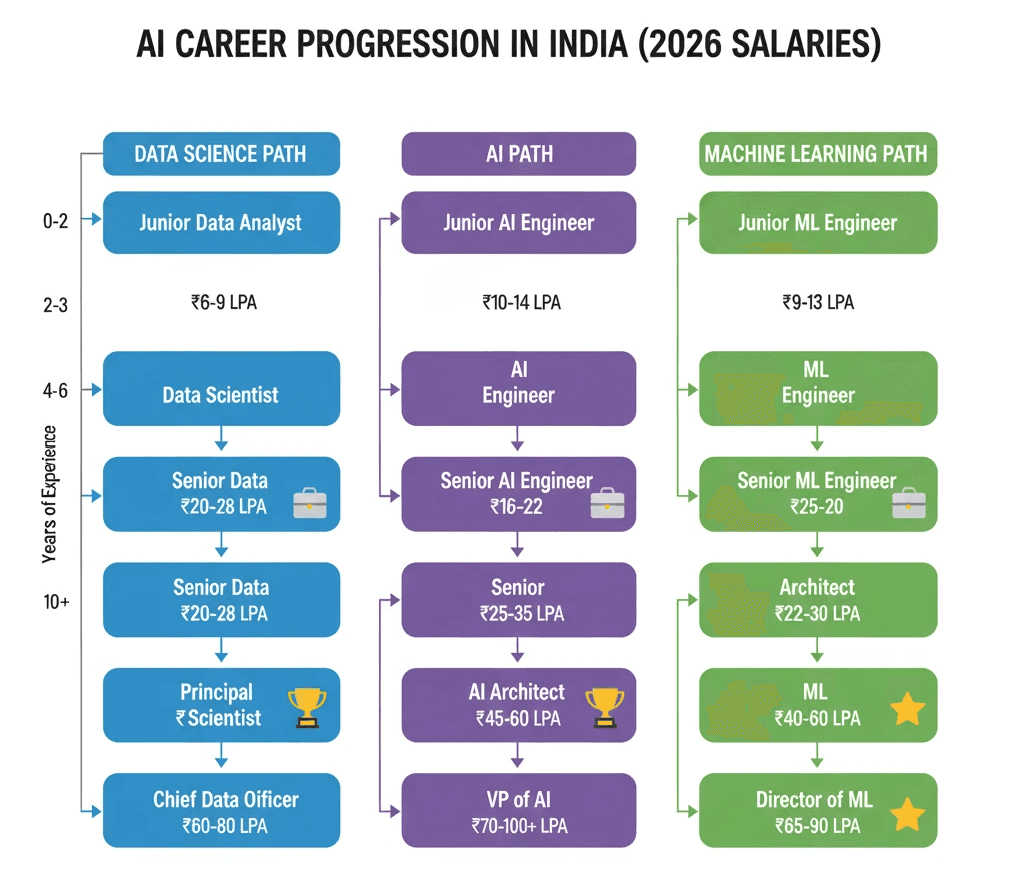
Data Science Career Path:
Entry Point: Junior Data Analyst or Associate Data Scientist
2-3 Years: Data Scientist or Senior Analyst
4-6 Years: Senior Data Scientist or Lead Analytics
7-10 Years: Principal Data Scientist or Analytics Manager
10+ Years: Director of Data Science or Chief Data Officer
Skills That Accelerate Growth: Business acumen and stakeholder management, strong communication skills, ability to lead analytics teams, understanding of multiple industries.
Peak Earning Potential: ₹50-80 LPA as CDO or Director.
AI Career Path:
Entry Point: Junior AI Engineer or AI Research Assistant
2-3 Years: AI Engineer or Applied AI Researcher
4-6 Years: Senior AI Engineer or AI Architect
7-10 Years: Principal AI Engineer or AI Research Lead
10+ Years: Head of AI or VP of AI Research
Skills That Accelerate Growth: Publishing research papers, contributing to open-source AI projects, specializing in cutting-edge areas, building production-grade AI systems.
Peak Earning Potential: ₹60-100+ LPA as VP or Head of AI.
Machine Learning Career Path:
Entry Point: Junior ML Engineer or ML Ops Engineer
2-3 Years: ML Engineer or Applied Scientist
4-6 Years: Senior ML Engineer or ML Architect
7-10 Years: Principal ML Engineer or Engineering Manager
10+ Years: Director of ML Engineering or VP of Applied Science
Skills That Accelerate Growth: Building scalable ML systems, expertise in MLOps and production, strong algorithm optimization skills, cross-functional collaboration ability.
Peak Earning Potential: ₹50-80+ LPA as Director or VP.
Which Field Has Fastest Growth?
Career growth speed depends on several factors. AI roles grow fastest in cutting-edge startups. ML roles grow steadily in established tech companies. Data Science roles grow well in traditional industries going digital.
Reality: Your individual growth depends more on your skills and the company you join than the field itself. All three paths offer excellent long-term prospects in 2026.
8. Which Career Should YOU Choose? (Decision Framework)
Here's a practical framework to help you decide based on your situation.
Choose Data Science If:
You enjoy solving business problems with data. You like communicating insights to non-technical people. You want to work across multiple industries. You prefer asking "Why?" and "What if?" questions. You're more interested in insights than building systems. You come from a business, economics, or statistics background.
Ideal Profile: Analytical mindset, business curiosity, good communication skills, comfortable with statistics.
Choose AI If:
You want to build intelligent systems from scratch. You're fascinated by how machines can think and learn. You enjoy reading research papers and implementing them. You want to work on cutting-edge technology. You're willing to specialize deeply in one AI area. You have strong mathematical foundations.
Ideal Profile: Problem solver, loves innovation, comfortable with ambiguity, strong technical depth.
Choose Machine Learning If:
You love mathematics and algorithms. You want to focus on model building and optimization. You enjoy getting hands dirty with code and data. You prefer building systems over presenting insights. You want to work in production ML environments. You like seeing your models impact millions of users.
Ideal Profile: Strong coder, loves optimization, detail-oriented, production-minded.
Based on Your Background:
Engineering Graduate (CSE/IT): Any path works. ML or AI might be easier entry.
Engineering Graduate (Non-CS): Start with Data Science, then specialize.
Commerce/Economics Graduate: Data Science is the best entry point.
Science Graduate (Math/Stats/Physics): ML is a natural fit given your math background.
Working Professional (Non-Tech): Data Science offers the smoothest transition.
Working Professional (Developer): ML or AI based on your interest.
Based on Your Goals:
Goal: Highest immediate salary? Choose AI or ML roles.
Goal: Easier job market entry? Choose Data Science initially.
Goal: Working with businesses? Choose Data Science.
Goal: Building innovative products? Choose AI.
Goal: Production systems at scale? Choose ML Engineering.
Goal: Research and publications? Choose AI Research track.
The Hybrid Approach (Recommended):
Here's what most successful professionals do. Start with Data Science fundamentals to understand data and business. Add ML skills for model building capability. Then specialize in one AI area if interested. This T-shaped skill approach makes you versatile and valuable.
Reality Check: You're not locked into one path forever. Many professionals start in Data Science and move to ML or AI. The skills are transferable, and companies value versatile talent.
9. How Edzor's IIT iHub Programs Prepare You
Choosing the right training program is crucial for your career success. Here's how Edzor's IIT iHub-certified programs align with each career path.
For Data Science Career:
Program: Data Science with Generative AI
Partner: Vishleshan iHub, IIT Patna
Duration: 6 months
What You'll Master: Python programming and statistics. Data manipulation with Pandas and NumPy. Machine Learning fundamentals. Data visualization and storytelling. Real-world capstone projects with datasets. Generative AI basics for modern workflows.
Career Outcomes: Prepared for Data Scientist, Data Analyst, and Business Intelligence roles. Alumni placed at TCS, Infosys, Deloitte, startups.
Salary Expectation Post-Course: ₹8-14 LPA for freshers, ₹15-22 LPA for experienced professionals.
For AI Career:
Program: Advanced AI and Machine Learning
Partner: TIH Foundation, IIT Palakkad
Duration: 6 months
What You'll Master: Deep learning architectures. Natural Language Processing fundamentals. Computer vision basics. Reinforcement learning concepts. Neural network implementation. Production AI system design.
Career Outcomes: Prepared for AI Engineer, NLP Engineer, and Applied AI Researcher roles. Focus on building intelligent systems.
Salary Expectation Post-Course: ₹10-16 LPA for freshers, ₹18-28 LPA for experienced professionals.
For ML Engineering Career:
Program: Both programs provide ML foundation
Recommended: Start with Data Science, then specialize with Cloud Computing program
Additional: Cloud Computing and DevOps (E&ICT IIT Guwahati)
What You'll Master: ML algorithms and implementation. Model training and optimization. MLOps and deployment pipelines. Cloud infrastructure for ML. Scalable system design. Production best practices.
Career Outcomes: Prepared for ML Engineer, MLOps Engineer, and Applied Scientist roles. Focus on production systems.
Salary Expectation Post-Course: ₹9-15 LPA for freshers, ₹16-26 LPA for experienced professionals.
Why IIT iHub Certification Matters:
Brand Recognition: Recruiters actively filter for IIT credentials. Your resume stands out immediately.
Industry-Aligned Curriculum: Courses designed with input from hiring companies. You learn what employers actually need.
Offline Learning Advantage: Classroom training at 25+ centres nationwide. Real-time doubt clearing and peer learning. Weekend batches for working professionals.
Placement Support: 85% placement rate within 6 months. Resume building and mock interviews. Direct company connections through job fairs. Alumni network for referrals.
ROI Timeline: Average salary increase of ₹5-8 LPA. Course investment recovered in 3-5 months. Lifetime value of IIT credential on resume.
Success Stories:
Rajesh Kumar - Data Scientist at Flipkart
Before Edzor: Software Developer, ₹6 LPA
After IIT Patna Program: Data Scientist, ₹15 LPA
Investment: ₹90,000 | ROI: 10 months
Priya Sharma - AI Engineer at Microsoft
Before Edzor: Testing Engineer, ₹5 LPA
After IIT Palakkad Program: AI Engineer, ₹18 LPA
Investment: ₹1,05,000 | ROI: 8 months
Amit Desai - ML Engineer at Razorpay
Before Edzor: Backend Developer, ₹8 LPA
After Combined Programs: ML Engineer, ₹22 LPA
Investment: ₹1,50,000 | ROI: 11 months
10. Frequently Asked Questions
Q1: Can I switch between these fields later in my career?
Absolutely. Many professionals start in Data Science and move to ML or AI. The foundational skills overlap significantly. You'll need 3-6 months to upskill when switching, but it's very common and valued by employers.
Q2: Which field is easier for complete beginners?
Data Science is the most accessible entry point. It requires less intensive mathematics compared to ML or AI. You can start with basic Python and statistics and gradually build complexity. Most beginners succeed faster with Data Science.
Q3: Do I need a PhD for AI research roles?
Not necessarily. While PhD helps for research scientist positions at top labs, many AI Engineer and Applied AI roles are open to candidates with strong portfolios and relevant certifications like IIT iHub programs. Focus on building projects and contributing to open source.
Q4: Which field has better job security in 2026?
All three fields show strong job security. Data Science roles are needed across all industries, providing stability. AI and ML roles are in high demand with fewer qualified candidates. Choose based on interest rather than security concerns.
Q5: Can I learn all three simultaneously?
Not recommended for beginners. It leads to shallow knowledge in all areas. Better approach: Master one field first, then add skills from others. Use the T-shaped skill model—deep expertise in one area, broad knowledge across related areas.
Q6: How important is mathematics for these careers?
For Data Science: Basic statistics is sufficient. Grade 11-12 level math works fine.
For AI: Strong mathematics required, especially linear algebra and calculus.
For ML: Very important, especially optimization theory and statistics.
Don't let math fear stop you. You can learn required math alongside practical projects.
Q7: Are online courses enough or do I need formal certification?
Online courses build skills but formal IIT iHub certification significantly improves job prospects. Recruiters trust recognized institutions. The combination of learning plus credential works best. Self-learning plus IIT certification gives maximum ROI.
Q8: Which field pays most in 2026 overall?
At entry-level, AI and ML pay 15-25% more. At senior levels, all three converge, but AI maintains slight edge. However, individual skills and company matter more than field choice. Excellence in any path leads to premium salaries.
11. Conclusion: Your Next Steps
You now have complete clarity on Data Science, AI, and ML career paths in 2026.
Here's what you learned:
Data Science focuses on extracting business insights from data. Best for those who enjoy solving business problems and communicating findings.
AI builds intelligent systems that can think and act autonomously. Best for innovators who want to work on cutting-edge technology.
Machine Learning implements algorithms that learn from data. Best for engineers who love optimization and production systems.
All three fields offer excellent salaries ranging from ₹6-100 LPA depending on experience. Skills overlap significantly, allowing career pivots. IIT iHub certification accelerates your journey significantly.
The Decision is Yours:
Don't overthink this choice. Pick the path that excites you most. You can always pivot later. The key is to start with quality training and build real projects.
Most importantly: The Indian tech industry needs all three types of professionals. Your success depends less on which path you choose and more on how deeply you commit to mastering it.